
NewsDetails
Quality Inspection Standards for Finished Power Hardware
author:Dachuan time:2026-04-17 17:23:51 Click:56
Quality Inspection Standards for Finished Power Hardware
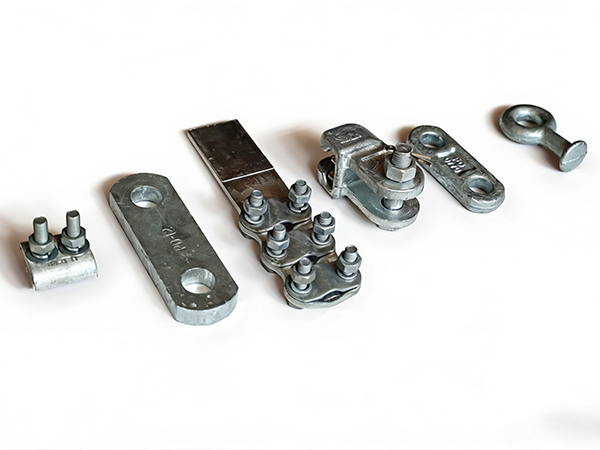
Finished power hardware (also called transmission line fittings or overhead line accessories) must undergo strict quality inspection before delivery and installation. These components operate under continuous mechanical load, electrical stress, and harsh environmental conditions, so any defect may lead to conductor failure, overheating, or system outage. Quality inspection ensures compliance with international standards and guarantees safe, long-term operation.
1. Purpose of Quality Inspection
The main objectives are:
Ensure mechanical strength and structural integrity
Verify electrical performance stability
Confirm corrosion resistance and coating quality
Eliminate manufacturing defects before delivery
Ensure compliance with IEC/IEEE standards
2. General Inspection Principles
All finished power hardware must follow these principles:
90% visual inspection for critical defects
Sampling inspection for mechanical and electrical tests
Traceability of batch and production records
Compliance with international standards (IEC, IEEE, ISO)
Consistency between design specifications and final product
3. Visual Inspection Standards
3.1 Surface Quality
Inspect for:
Cracks, pores, or shrinkage defects
Burrs and sharp edges
Deformation or casting defects
Uneven galvanizing or coating
3.2 Assembly Quality
Check:
Proper alignment of components
Correct installation of bolts, pins, and locking devices
No missing parts or misassembly
Clear and readable markings
3.3 Surface Coating Appearance
Uniform color and texture
No bare metal exposure
No peeling or blistering
No excessive zinc lumps or slag inclusion
4. Dimensional Inspection Standards
4.1 Key Dimensional Parameters
Groove diameter and shape accuracy
Hole spacing and alignment
Overall geometry and tolerances
Thread compatibility for bolts and connectors
4.2 Measurement Methods
Calipers and micrometers
Coordinate measuring machines (CMM)
Go/no-go gauges for batch inspection
5. Mechanical Performance Inspection
5.1 Tensile Strength Test
Must meet or exceed rated conductor load
No permanent deformation under rated stress
Safety factor typically 2.5–5
5.2 Slip Resistance Test
Ensures conductor does not move under load
Critical for tension clamps and strain fittings
5.3 Fatigue Test
Simulates wind vibration and long-term cyclic loading
Ensures no crack initiation or propagation
5.4 Impact Resistance Test
Evaluates resistance to sudden mechanical shock
Important for low-temperature environments
6. Electrical Performance Inspection
6.1 Contact Resistance Test
Ensures low-resistance electrical connection
Prevents overheating at joints
6.2 Temperature Rise Test
Measures heating under rated current
Must remain within allowable thermal limits
6.3 Corona Performance Test (≥110kV)
Checks discharge under high voltage
Ensures smooth electric field distribution
6.4 Partial Discharge Test (High Voltage Applications)
Detects internal defects or insulation issues
Ensures long-term reliability
7. Coating and Corrosion Resistance Inspection
7.1 Galvanizing Thickness Test
Measured using magnetic thickness gauges
Must meet IEC 1461 requirements
7.2 Adhesion Test
Hammer test or bending test
No peeling or flaking allowed
7.3 Salt Spray Test
Simulates coastal or industrial environments
Evaluates long-term corrosion resistance
8. Material Quality Verification
8.1 Chemical Composition Analysis
Ensures material meets specification
Detects harmful impurities
8.2 Metallographic Inspection
Grain structure analysis
Detection of internal defects
8.3 Hardness Testing
Ensures proper heat treatment
Confirms wear resistance capability
9. Batch Sampling Inspection Rules
9.1 Sampling Standards
Random sampling from each production batch
Increased sampling rate for critical fittings
90% inspection for high-voltage critical components
9.2 Acceptance Criteria
Zero tolerance for critical defects (cracks, deformation)
Strict limits for dimensional deviation
Statistical process control (SPC) monitoring
10. Packaging and Labeling Inspection
10.1 Packaging Requirements
Shock-resistant and moisture-proof packaging
Protection against coating damage
Secure fastening of components
10.2 Labeling Requirements
Voltage level identification
Batch number and traceability code
Manufacturer identification
Installation instructions if required
11. Common Quality Defects Found in Inspection
Porosity or internal casting defects
Incomplete galvanizing coverage
Loose or misaligned assembly parts
Incorrect dimensional tolerances
Poor surface finishing or burrs
Insufficient mechanical strength
12. Compliance with International Standards
Finished power hardware must comply with:
IEC 61284 – Overhead line fittings requirements
IEC 60372 – Locking devices for fittings
IEC 60826 – Design criteria for overhead lines
ISO 1461 – Hot-dip galvanized coatings
IEEE Std 524 – Installation guidelines
ISO 9001 – Quality management systems
Conclusion
Quality inspection of finished power hardware is a comprehensive process covering visual, dimensional, mechanical, electrical, and environmental performance testing. Strict adherence to international standards ensures that each component meets the required safety and performance levels. A robust inspection system significantly reduces field failure risk, improves operational reliability, and extends the service life of transmission line systems.
References
IEC 61284 – Overhead lines requirements for fittings
IEC 60826 – Design criteria for overhead transmission lines
IEEE Std 524 – Installation guide for overhead line conductors
ISO 1461 – Hot-dip galvanized coatings
IEC 61238 – Compression and mechanical connectors
CIGRÉ Technical Brochures on quality assurance of transmission line hardware
 Recommended Products
 Contact us
—— Contact:Manager
—— Tel:+86 15631793633
—— Email:960244024@qq.com
—— Url:https://www.dachuan-power.com
—— Address:Liugusi Town, Hejian City, Cangzhou City, Hebei Province, China