
NewsDetails
Hot_Dip_Galvanized_Power_Fittings_Why_It_Matters_for_Durability
author:Dachuan time:2026-07-12 08:06:09 Click:196
The Problem of Corrosion in Outdoor Power Hardware
Mild steel, the primary material for pole line hardware, is an excellent structural material but is thermodynamically unstable in the presence of moisture and oxygen. The iron in steel naturally oxidizes to form iron oxide — commonly known as rust. Unlike aluminum, which forms a stable, self-limiting oxide layer, iron oxide is porous and flaky, allowing moisture and oxygen to penetrate deeper into the metal and accelerate the corrosion cycle.
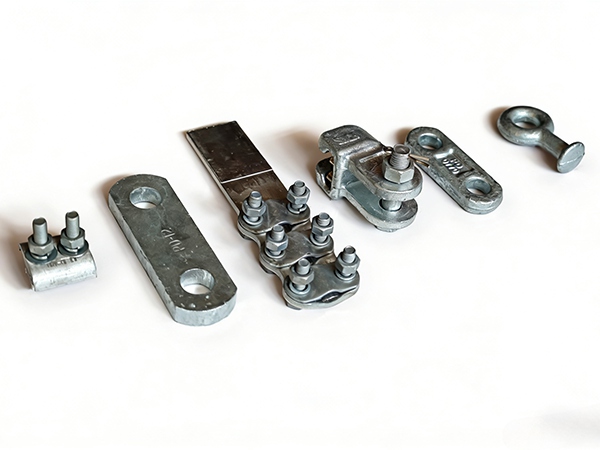
In overhead line applications, corrosion is especially concerning because hardware is often difficult to inspect and replace without costly outages or climbing operations. A fitting that fails due to corrosion-induced weakness can lead to dropped conductors, pole fires, or cascade failures during storms.
How Hot-Dip Galvanizing Works
Hot-dip galvanizing is a metallurgical process in which fabricated steel parts are immersed in a bath of molten zinc at approximately 450 degrees Celsius. The zinc reacts with the steel surface to form a series of zinc-iron alloy layers bonded directly to the substrate, with a layer of essentially pure zinc on the outer surface. This alloy bonding is fundamentally different from simply painting zinc onto steel — the coating is metallurgically bonded and cannot peel, flake, or chip off the way paint does.
The result is a multi-layered coating system: the outer pure zinc layer provides barrier protection, while the alloy layers provide both barrier and sacrificial protection. Even if the coating is scratched down to bare steel, the surrounding zinc acts as a sacrificial anode, corroding preferentially to protect the underlying steel from further damage.
Standards Governing Galvanizing Quality
Two international standards are most commonly referenced for hot-dip galvanized coatings on power line hardware. ASTM A123 covers structural steel products including fittings, cross arms, and pole hardware, specifying minimum coating thicknesses based on the steel thickness of the article. ISO 1461 provides the international equivalent with similar requirements and test methods.
For small fasteners and hardware, ASTM A153 specifies coating requirements for individual parts. These standards also define acceptable surface condition, repair procedures for damaged coating areas, and test methods for verifying compliance in the factory.
Thickness and Longevity Expectations
Coating thickness directly correlates with service life. In a typical rural or suburban environment, a galvanized coating of 85 microns provides 30 to 50 years of protection before first maintenance is needed. In severe marine or industrial environments, the same coating may last 15 to 25 years. The thicker the coating, the longer the service life of the hardware.
Power line fittings vary in steel thickness, and the galvanizing process naturally produces thicker coatings on heavier sections. An angle steel cross arm with a material thickness of 8mm will emerge from the galvanizing bath with a coating of 85 microns or more, while thinner brackets may have coatings in the 45 to 65 micron range.
Galvanizing vs Other Coating Methods
Alternative coating methods include electroplating, which produces thinner and less durable zinc coatings, sherardizing for small parts, paint systems including epoxy and zinc-rich primers, and zinc-aluminum alloy thermal spraying. While each method has its applications, hot-dip galvanizing remains the most cost-effective and durable option for the range of steel thicknesses found in overhead line hardware supplied to utilities worldwide.
Choosing a Manufacturer With Proper Galvanizing Facilities
Not all hardware manufacturers have in-house galvanizing capability. Some outsource this critical step to external galvanizers, which adds handling costs, extends lead times, and reduces traceability. A factory with its own galvanizing kettle can control pre-treatment chemistry, zinc bath temperature, immersion time, and post-dipping inspection to deliver consistently compliant coatings batch after batch.
Conclusion
Hot-dip galvanizing is the backbone of durability for overhead power line hardware. Specifying galvanized fittings in accordance with ASTM A123 or ISO 1461, and sourcing from manufacturers who control the galvanizing process in-house, is the most effective way to ensure long-term performance and minimize lifecycle maintenance costs for power distribution infrastructure.
References
ASTM A123 — Standard Specification for Zinc (Hot-Dip Galvanized) Coatings on Iron and Steel Products
ISO 1461 — Hot Dip Galvanized Coatings on Fabricated Iron and Steel Articles
IEC 61284 — Overhead Line Fittings — Requirements and Tests
IEEE NESC C2 — National Electrical Safety Code
We warmly welcome global distributors to partner with us — together we can deliver reliable power line hardware solutions to markets worldwide.
 Recommended Products
 Contact us
—— Contact:Manager
—— Tel:+86 15631793633
—— Email:960244024@qq.com
—— Url:https://www.dachuan-power.com
—— Address:Liugusi Town, Hejian City, Cangzhou City, Hebei Province, China