
NewsDetails
Practical Application of Custom Iron Fittings in Special Engineering Projects
author:Dachuan time:2026-04-17 14:03:11 Click:104
Practical Application of Custom Iron Fittings in Special Engineering Projects
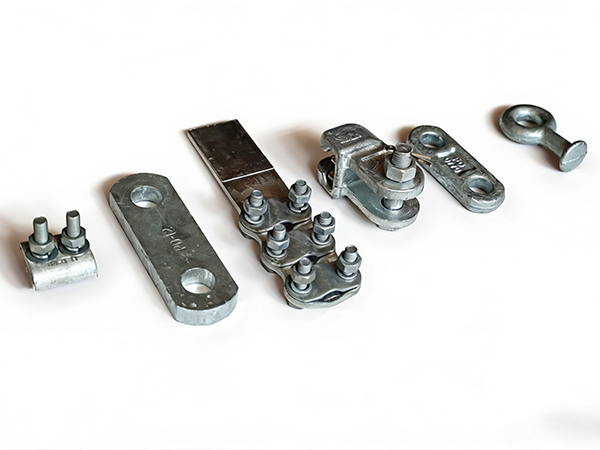
Custom iron fittings play an increasingly important role in special engineering projects where standard components cannot fully meet structural, environmental, or operational requirements. These fittings are engineered based on project-specific loads, geometry, installation constraints, and service conditions, ensuring reliable performance in complex or non-standard applications.
1. Overview of Custom Iron Fittings
Custom iron fittings refer to specially designed and manufactured metal components used in power, infrastructure, and industrial engineering projects. Unlike standard fittings, they are tailored to specific requirements such as:
Non-standard structural configurations
Extreme environmental conditions
High-load or dynamic load requirements
Special electrical or mechanical constraints
Common materials include carbon steel, alloy steel, ductile iron, and stainless steel, typically protected by hot-dip galvanizing or advanced coatings.
2. Application Areas in Special Engineering Projects
2.1 High-Voltage Transmission Projects
Custom fittings are widely used in:
Ultra-high voltage (UHV) transmission lines
Long-span river or valley crossings
High-altitude transmission corridors
They are designed to handle increased mechanical tension, wind load, and ice accumulation.
2.2 Complex Terrain Installations
In mountainous or uneven terrain:
Custom angle fittings adjust to non-standard tower geometries
Reinforced brackets compensate for uneven load distribution
Flexible connection systems accommodate ground movement
2.3 Urban Power Distribution Systems
In dense urban environments:
Compact fittings are designed for space-limited installations
Low-profile cross arms reduce visual impact
Special clamps support aerial bundled cables (ABC systems)
2.4 Industrial and Chemical Zones
In corrosive environments such as chemical plants or coastal facilities:
Stainless steel or high-grade galvanized fittings are used
Enhanced coatings improve corrosion resistance
Sealed or protected connections reduce contamination risk
2.5 Renewable Energy Infrastructure
Custom fittings are also used in:
Wind farm transmission connections
Solar power grid integration systems
Hybrid renewable energy substations
They ensure structural stability under variable load conditions.
3. Design Considerations for Custom Iron Fittings
3.1 Load-Specific Engineering
Design must account for:
Static loads (equipment weight)
Dynamic loads (wind, vibration, seismic activity)
Emergency loads (fault currents, conductor breakage)
Finite Element Analysis (FEA) is commonly used for optimization.
3.2 Material Selection
Material choice depends on:
Mechanical strength requirements
Corrosion resistance needs
Temperature and environmental exposure
Advanced alloy steels or stainless steels are often selected for critical applications.
3.3 Geometric Customization
Non-standard shapes for unique structural interfaces
Reinforced sections at stress concentration areas
Optimized load paths to reduce material usage
3.4 Compatibility and Integration
Must integrate with existing tower or pole systems
Ensure compatibility with conductors, insulators, and fasteners
Maintain standard connection interfaces where possible
4. Manufacturing and Quality Control
4.1 Precision Manufacturing
CNC machining for high-accuracy components
Forging and casting for complex shapes
Welding for structural assemblies
4.2 Surface Treatment
Hot-dip galvanizing for corrosion protection
Powder coating or specialized coatings for harsh environments
Inspection of coating thickness and uniformity
4.3 Testing and Verification
Tensile and load testing for structural strength
Fatigue testing for cyclic load performance
Dimensional inspection for installation accuracy
5. Installation Considerations
Follow project-specific installation drawings
Ensure correct alignment with structural components
Use calibrated torque tools for fasteners
Verify field adjustments for terrain or structural variations
Proper installation is critical due to the non-standard nature of custom fittings.
6. Performance Advantages
High adaptability to complex engineering conditions
Improved structural reliability under extreme loads
Enhanced corrosion resistance in specialized environments
Optimized material usage and weight reduction
Increased system lifespan and reduced maintenance requirements
7. Challenges and Limitations
Higher design and manufacturing cost compared to standard fittings
Longer production lead time
Requires detailed engineering input and coordination
Complex quality control requirements
8. Future Development Trends
Integration of digital design and simulation tools
Use of advanced high-strength and lightweight materials
Increased adoption of modular custom fitting systems
Smart monitoring integration for structural health assessment
Greater standardization of custom interface designs
9. Conclusion
Custom iron fittings are essential in special engineering projects where standard solutions are insufficient. Their ability to adapt to unique structural, environmental, and operational requirements makes them a critical component in modern power infrastructure and industrial applications. Through advanced design, precise manufacturing, and rigorous testing, custom fittings ensure safety, reliability, and long-term performance in challenging engineering environments.
References
IEC 61284 – Overhead lines – Requirements and tests for fittings
IEC 60826 – Design criteria of overhead transmission lines
IEEE Standard 605 – Guide for Design of Substation Rigid-Bus Structures
ASTM A153/A153M – Zinc Coating (Hot-Dip) on Iron and Steel Hardware
CIGRÉ Technical Brochures on Overhead Line Hardware and Special Applications
 Recommended Products
 Contact us
—— Contact:Manager
—— Tel:+86 15631793633
—— Email:960244024@qq.com
—— Url:https://www.dachuan-power.com
—— Address:Liugusi Town, Hejian City, Cangzhou City, Hebei Province, China