
NewsDetails
Hot-Dip Galvanizing Technology for Anti-Corrosion of Power Fittings
author:Dachuan time:2026-04-17 14:04:06 Click:77
Hot-Dip Galvanizing Technology for Anti-Corrosion of Power Fittings
Hot-dip galvanizing (HDG) is one of the most widely used anti-corrosion technologies for power iron fittings in overhead transmission and distribution systems. It provides a durable zinc coating that protects steel components from environmental degradation, significantly extending service life in outdoor and harsh operating conditions.
1. Overview of Hot-Dip Galvanizing
Hot-dip galvanizing is a metallurgical process in which steel or iron components are immersed in molten zinc at approximately 450°C. During this process, a series of zinc-iron alloy layers form on the surface, creating a strong, bonded protective coating.
The coating acts as both a physical barrier and a sacrificial anode, meaning zinc corrodes preferentially to protect the underlying steel.
2. Process Flow of Hot-Dip Galvanizing
2.1 Surface Preparation
Proper surface cleaning is essential for coating quality:
Degreasing: removes oil, grease, and organic contaminants
Pickling: removes rust and mill scale using acid solutions
Fluxing: prevents oxidation before immersion in molten zinc
2.2 Galvanizing Stage
Components are immersed in molten zinc bath
Zinc reacts with iron to form alloy layers
Typical immersion time depends on part size and thickness
2.3 Cooling and Finishing
Parts are withdrawn and cooled in air or water
Excess zinc is removed by drainage or vibration
Surface inspection ensures uniform coating
3. Structure of Zinc Coating
The coating consists of multiple metallurgical layers:
Outer layer: pure zinc (ductile and corrosion-resistant)
Intermediate layers: zinc-iron alloy phases (hard and adherent)
Inner layer: bonded interface with steel substrate
This layered structure provides both toughness and long-term protection.
4. Anti-Corrosion Mechanism
Hot-dip galvanizing protects steel through two key mechanisms:
4.1 Barrier Protection
Zinc coating isolates steel from moisture, oxygen, and pollutants
Prevents direct contact with corrosive environment
4.2 Sacrificial Protection
Zinc acts as a sacrificial anode
Even if coating is damaged, surrounding zinc continues to protect exposed steel
This electrochemical protection is highly effective in outdoor environments
5. Performance Advantages in Power Fittings
5.1 Long Service Life
Typically provides 20–50 years of corrosion protection depending on environment
Reduces maintenance frequency
5.2 Strong Adhesion
Metallurgical bonding ensures coating does not peel or flake easily
Suitable for mechanical stress environments
5.3 Uniform Coverage
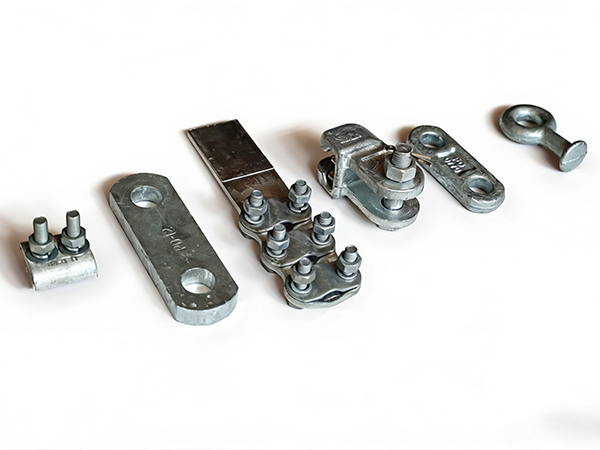
Coats complex shapes such as bolts, clamps, and fittings evenly
Provides protection in corners and hard-to-reach areas
5.4 Cost Efficiency
Low lifecycle cost compared to painting or other coatings
Minimal maintenance requirements
6. Design Considerations for Galvanized Power Fittings
6.1 Material Compatibility
Most carbon steels and low-alloy steels are suitable
Avoid materials prone to excessive brittleness after galvanizing
6.2 Venting and Drainage Design
Holes must be designed for proper zinc flow and air escape
Prevents air pockets and coating defects in hollow structures
6.3 Dimensional Tolerance
Coating thickness increases final dimensions
Allowance must be considered in design for threads and assemblies
6.4 Thread Protection
Threads may require post-processing or re-threading
Oversized tapping before galvanizing is often used
7. Quality Control Standards
Hot-dip galvanizing quality is governed by international standards:
ISO 1461 – Hot-dip galvanized coatings on fabricated iron and steel
ASTM A153/A153M – Zinc coating on iron and steel hardware
ASTM A123 – Zinc coatings on iron and steel products
IEC 61284 – Overhead line fittings requirements
Key quality parameters include:
Coating thickness
Adhesion strength
Surface uniformity
Absence of defects such as runs, drips, or bare spots
8. Environmental Performance
Hot-dip galvanized coatings perform well in:
Rural and urban environments
Coastal regions (moderate exposure)
Industrial atmospheres with pollutants
However, in highly aggressive environments (e.g., strong acid or chemical exposure), additional protective coatings may be required.
9. Common Defects and Prevention
9.1 Uneven Coating
Cause: improper surface preparation
Solution: strict cleaning and flux control
9.2 Zinc Drips or Runs
Cause: improper withdrawal speed
Solution: controlled lifting and drainage
9.3 Poor Adhesion
Cause: contamination or oxidation before galvanizing
Solution: improved pre-treatment process
9.4 Excessive Thickness
Cause: long immersion time or high bath temperature
Solution: process optimization
10. Future Development Trends
Zinc-aluminum-magnesium (ZAM) coatings for enhanced corrosion resistance
Automated galvanizing process control systems
Environmentally friendly flux and waste treatment systems
Combination coatings (galvanizing + polymer topcoats)
Digital monitoring of coating quality
11. Conclusion
Hot-dip galvanizing is a mature and highly effective anti-corrosion technology widely used in power iron fittings. Its combination of barrier protection and sacrificial action provides long-term durability in outdoor environments. With proper design, strict process control, and compliance with international standards, galvanized fittings ensure reliable performance and extended service life in modern power transmission and distribution systems.
References
ISO 1461 – Hot-dip galvanized coatings on fabricated iron and steel articles
ASTM A153/A153M – Zinc coating (Hot-Dip) on iron and steel hardware
ASTM A123 – Zinc (Hot-Dip Galvanized) coatings on iron and steel products
IEC 61284 – Overhead lines – Requirements and tests for fittings
CIGRÉ Technical Brochures on Corrosion Protection of Overhead Line Hardware
 Recommended Products
 Contact us
—— Contact:Manager
—— Tel:+86 15631793633
—— Email:960244024@qq.com
—— Url:https://www.dachuan-power.com
—— Address:Liugusi Town, Hejian City, Cangzhou City, Hebei Province, China